What’s The Worst You Ever Bombed?

Failure has become popular among the circles of writers and speakers I pay attention to, a trend I think is very healthy if not a little over-enthusiastically endorsed some of the time. So I love “The Worst I Ever Bombed,” the web exclusives posted by The Tonight Show where comedians share truly horrific stories of their worst performances (see Rob Riggle below).

Bombing isn’t always a performance. I’ve bombed at the supermarket as my kid’s toddler tantrum spilled all over the produce section. I’ve bombed in small talk (“So when are you due? What’s that? Oh you’re not pregnant? Awesome). I bomb in marriage all the time. One time I gave my wife a Christmas gift about which she had to seriously had to ask me–with a straight face–“Is this a joke?”

What’s the worst you ever bombed?

I did a Children’s Sermon about six years ago only minutes after my wife and I had sniped at each other on the church patio. With my lavaliere mic on. So things were already shaky. Then mere seconds into my story about Jesus feeding the 5,000, I made the rookie mistake of soliciting a response from the kids. They obliged. One girl in particular obliged more than her peers, launching into a story all her own.

I politely cut her off after several seconds and continued about Jesus, but every time I took a breath, this little girl picked up her story right where she’d left off. After about five of these interruptions, the congregation started to chuckle. By her eight or ninth intrusion there was open guffawing going on, so I stopped my story and implored the congregation, “What would you do?!”

A loud chorus of laughter followed, which had the immediate effect of shaming this poor little girl. As she buried her head in her hands I did my best to assure her that they were laughing at me and not her. Bomb.

I prematurely ended the story, leaving a hungry crowd and a humiliated kid.

What’s the worst you ever bombed?
Spies Among Us

Our work is only partly for its proper objects.

The teacher works for his students, the pediatrician for her patients, the CEO for her shareholders. These are the proper objects of their work.

Yet we all also work for spies who are watching our habits and our smallest decisions and who can benefit tremendously from our craft.

I thought of his while watching a photographer take a portrait of my daughter. He was so thorough and so fluid in his work that I couldn’t help but want to imitate him in mine. His work was not for me, but it totally was.

Let’s beware of spies and wow them.

“We have a responsibility to stay abreast of the conflicts in the world so that we can support or reject our leaders’ efforts to navigate them.”

So says Charles M. Blow in yesterday’s New York Times.

I recommitted to that daily paper a few weeks ago, and now I’m paying a price of that commitment that exceeds the monthly subscription fee. It’s a mental and spiritual cost; I feel more tired and more discouraged, less hopeful, and, ironically, less engaged in the world around me.

I understand Gaza, Ukraine, and Ebola better now than before. But I honestly wonder what good my “staying abreast” of those conflicts is doing anyone.

The allure of ignorance is strong these days.

Listening To Dreams

http://rd.io/x/QEq_KzNIqA/


I had a dream last night in which I led a youth mission project alongside one of the former Youth Directors at my church. I can’t say which one it actually was; it was something of an amalgam of two. As we picked up trash on a hill, I questioned my predecessor on the congregation’s youth ministry of yesteryear. Her answers crushed me. Things were so much better then.

One specific question I remember. I asked, “What about graduates who stick around and don’t leave the area for college. Did you still do work with them?”

“Oh yes,” she answered, “I worked very hard at that.”

Dreams are weird. I have an inferiority complex. There’s nothing new under the sun.

Still, though, I’m listening.


10 Learnings from The Youth Mission Trip

Note: this is the fourth post about a recent youth mission trip. The first three are here, here, and here.

This work trip was the first of its kind: a collaboration between four youth workers to assemble a team of over 40 high school youth from eight different churches for a 10 day mission experience. Here are the most important things we learned.

  1. A grilled cheese is a sandwich
  2. There are high school students who would like nothing more than to high five you in the face with a bus.
  3. The Abiquiu Teen Project is amazing
  4. 51 people is too many to do much meaningful work. Smaller=more flexible=better.
  5. Mosquitos have absolutely no redeeming biological or ecological function.
  6. The Dart Game is a disease.
  7. If your bus driver’s name is “Porsche,” it’s not actually that funny to repeatedly say, “Bring the Porsche around.”
  8. High school students want to worship God, especially under a blazing night sky on top of a mountain.
  9. The “O! A Milkshake” energizer is a fly that will torment your ears to the death.
  10. We’re definitely doing it again!


Why I’m Banning The Phone Ban

Note: this is the third post on our high school mission trip. The first two posts are here and here.

This is the last mission trip where I bar students from having their phones. The last.

I can’t speak for my co-leaders, but I’m done policing students on this. For a few reasons: the phone ban is difficult to enforce; phones–like it or not–are thoroughly intertwined with basic daily functions; it’s patronizing.

Enforcing a phone ban is a terrible waste of leadership time and energy on a mission trip. We asked every student before they got on the bus, “Do you have a phone?” Because they and their parents had been told in very clear terms that phones were NOT ALLOWED, every one of them answered, “No.”

Lies. We discovered at least a dozen phones during the trip. One student justified her phone’s presence by admitting that her mother had instructed her to call home every night, despite the ban. Who is she to obey? Mom or the youth leader?

A student sitting right next to me on the bus took his phone out of his pocket, and, when I called him on it (“Hey, you’re not supposed to have that.”), be blushed. I told him to hand it over.

“No.”

Just no.

What could I do? Wrestle him for it?

“I’m very disappointed.”

Yuck.

After conscientious students who had observed the ban started justifiably complaining about those who had not, we did a sweep, promising not to apprehend the devices but threatening discipline if they were used to text or make calls–in other words, as phones. This is the part about phones’ enmeshment in our lives. Music players, video game systems, cameras: phones get used every day for so many  things unrelated d to communication, things that we otherwise allowed on the trip, that banning them creates a hardship.

Conscious of this, we leaders urged students to bring separate cameras and iPods and video games. All those things were allowed. Some students brought none of those things. Some brought three separate things. Some brought their phones.

The camera is the thorniest piece of this puzzle. Your phone camera is the one you use every day and most easily. It seems unnecessary for mission trip leaders to demand you bring one don’t normally use just because you can’t text with it.

Most importantly of all, the phone ban is patronizing. I had my phone. I used it to call home to my wife and daughter, and I was very uneasy with the distinction that practice asserted between the importance of my family and students’ families. If this was an adult mission trip, there would be no phone ban. It’s that simple. Implementing one for high school students treats them less like the adults we want them to become and more like children.

Negotiating the role of our phones is a terrific community-building opportunity on mission trips, indeed, in all of our youth ministry gatherings, because it gets at our expectations of attention and presence from one another. Inviting students to both articulate and enforce their own expectations of one another in this regard is a better practice, I’m convinced, than issuing a unilateral ban.

That’s why I’m banning the phone ban.

Forget The Instructions

Note: this is the second of four posts reflecting on this year’s high school mission trip. Find the first post here.

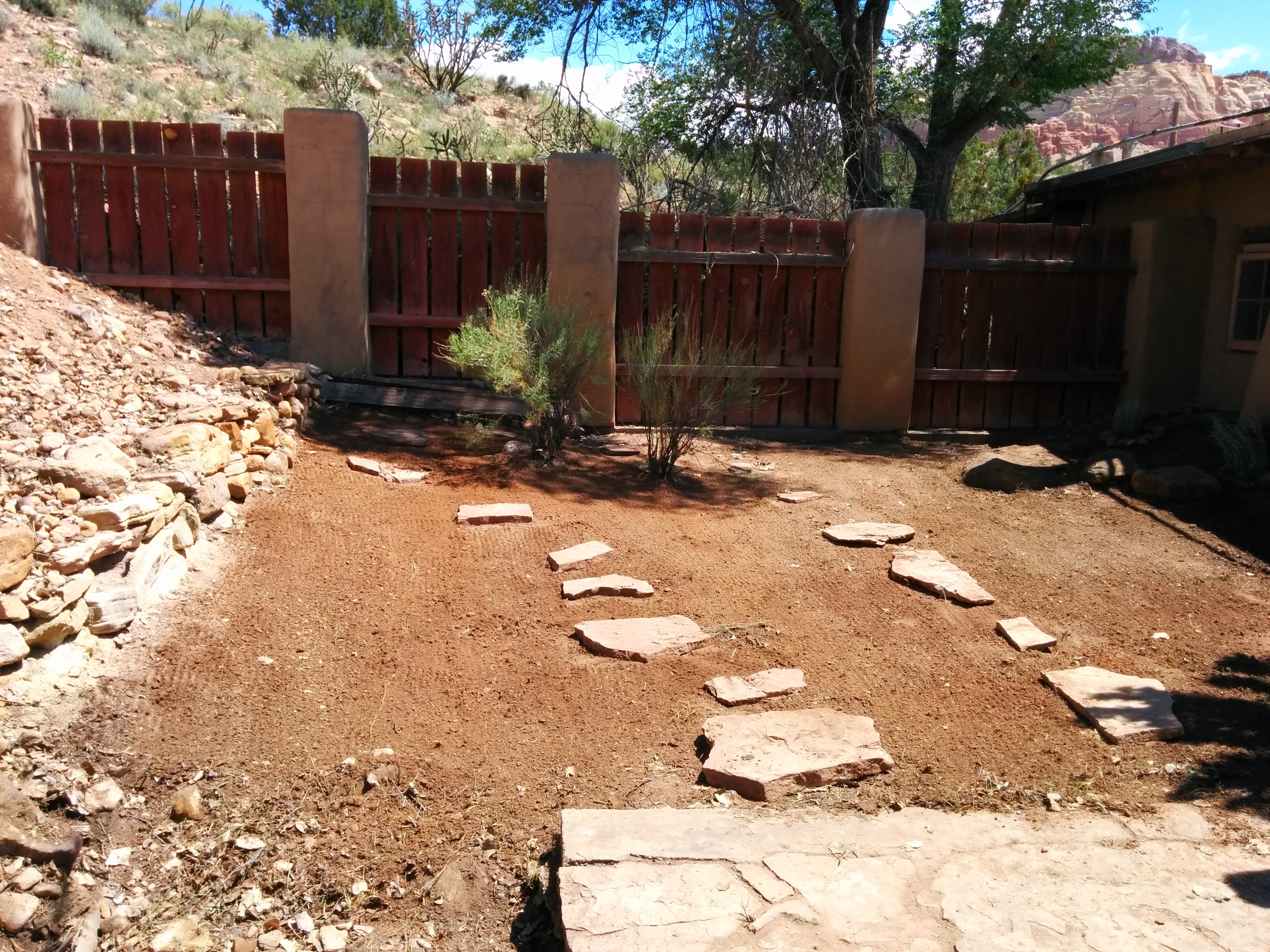
So it’s our last day of service. Our project is straightforward, and the instructions are simple: clear brush and weeds from a patch of dirt and an arroyo behind one of the ranch’s office buildings. There are about 20 of us. The mood is jovial. There’s even a game of Truth or Dare going on.

But a few students can’t get into it. I’m doing my best to rally some enthusiasm with upbeat talk, positive reinforcement, and even my own example as I dig in the dirt to uproot pesky weeds. But they’re not responding. They sit listless in the dirt and pathetically poke at the weeds with their hand trowels. I’m despondent.

Then, with about 10 minutes left to work, one of them catches a vision of our little dirt patch as a zen garden. He enlists two of his peers to help him clear the rest of the area of weeds, and then the three of them two-hand heave discarded rocks to form two walking paths. Then they rake the thing into a placid sea. Repeatedly they’re told to stop, that it’s time to go to lunch. But, as they’ve done all morning, they ignore those instructions and work til they were satisfied.

Mission is more than following instructions. It’s following a vision of an alternative future more compelling than mere maintenance and blowing through stop signs. Sometimes mission means making better instructions.

IMG_20140801_120030


Of Course It Was Bad

I got back from a 10 day work trip with 51 people yesterday, 40 of them high school students. I’ve got four posts for the week reflecting on it. 

First off: of course it was bad. 

When I stepped off the bus and onto our church parking lot pavement, a parent asked me, “Everything go okay?” I reflexively answered, “No.”

He seemed startled. So I expanded with some guilt about how things are bound to go wrong in a 10 day mission effort involving that many people. On balance, the trip was good–great even: transformative, powerful, encouraging. But some things were off. Hundreds of mosquito bites, too little sleep, arguments, a midnight ER visit. 

The power of mission comes from the things that go badly more than the things that go well. The leaders of our trip became experts in arranging restaurant meals from 51 people, and they all went incredibly well, given the challenges. But I doubt our students will carry an impression of those meals as deep as the one made by their unexpected early morning embrace of a student who had to make an unplanned early departure. 

PANO_20140804_114507

Also, if nothing goes badly, what are we learning?

I Wanna Get Better


It’s annual personnel review season here at the church. and this year we’re using a new narrative template for these things. I like it a lot. Here’s one of the questions:

Are there particular skills or areas of professional development you would like to undertake during the coming year?

Yes. Yes there are.

I want to get better at leading change . I want to learn strategies for forming self-learning groups. And some other stuff.

I want to get better.

What about you? 12 months from now, what do you want to be better at?

Is Church A League Or A Team?

People play recreation league softball for different reasons. Some are there to play a game they love and get better at it. Some want the competition. Others need the physical activity. Still others do it for the regular social interaction. The community softball league is a durable institution because people want to do it for lots of different reasons ranging from the competitive and athletic to the social.

Some teams are young, brash, and win a lot. Others are slow and laid back, and they don’t win as much. They don’t care as much either. The fiery competitor will be frustrated on the laid back team, and the team won’t take well to her. Same is true of the duffer on the team of hot shots.

Of course this makes me think about church. There’s a line of thinking that churches need simple expressions of themselves that everyone can rally around, things like, “Bible-based” or “Inclusive” or “Missional.” That seems to me to make a team out of church, rather than a league.

Which is better?