Education

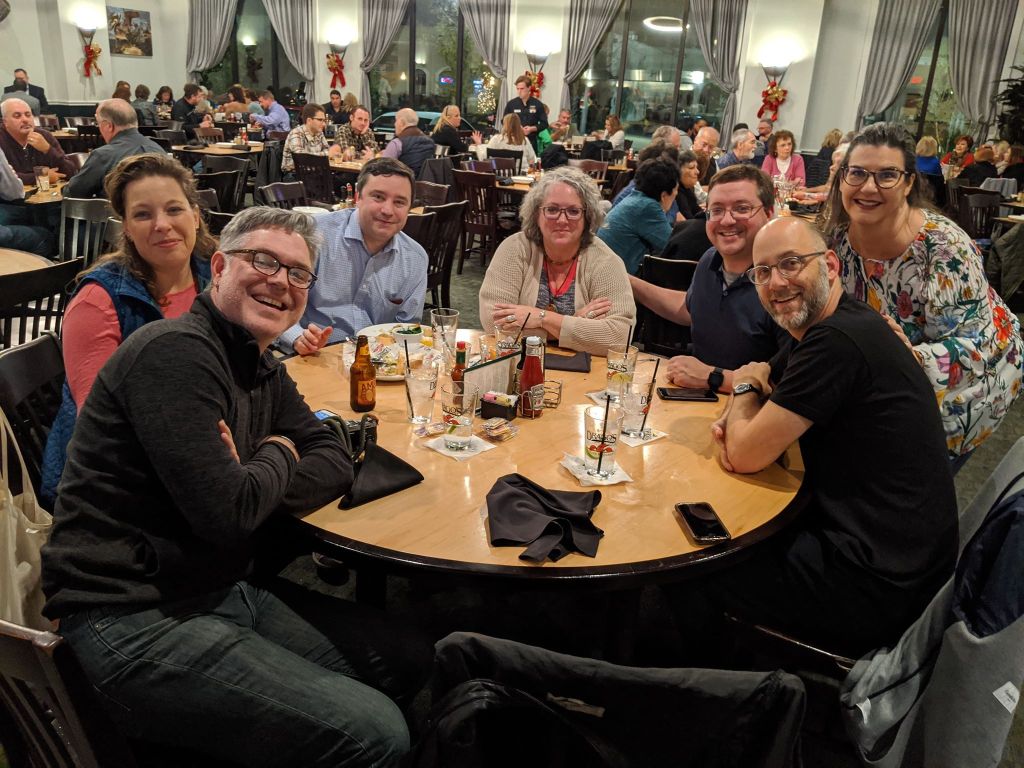
I’m back home after three days with my continuing education group, six colleagues who I’ve joined for two days of mutual discernment for six years now. We’re a mixed group: some of us serve churches, some don’t. Some have kids, some don’t. Some are in their 30’s, some in their 40’s, some in their 50’s. We live in Idaho, Illinois, Kansas, Missouri, Florida, and Oklahoma.

If you have a people like that who you can solicit for advice and perspective in a structured environment, you’re livin’ well. If you don’t, you can fashion one; we didn’t always have this. We made it. And we keep choosing to make it, even though some years it feels well nigh impossible (and some years is for some of us). It will serve you well this year, in five years, and probably well beyond, which is not even to mention the service you will render it.
Stress

The opposite of stress is purpose.

My experience of stress–at least the lose-sleep-at-night-and-eat-your-feelings kind of stress–is that it visits me when I’m afraid of failing and afraid of letting people down, afraid of disappointing people. There is no technical fix for that; you can’t drink enough water or eat enough vegetables to conquer that. It’s not a technical problem.

That kind of stress is a spiritual problem. Can we experiment with translating our fear into purpose? Instead of chewing my nails off because I’m worried about a deadline, can I find what I love about the project that’s due, why I’m even doing it, and feel free to produce something that reflects what I love about it?

That feels like such a luxury, a privilege even. Maybe it is. But the stoic acceptance of eat-yourself-inside-out stress as an indicator of significance will kill us. Worse, it will leave all those people we’re worried about letting down in the lurch.

The opposite of stress isn’t relaxation. It’s purpose.

Realize

“Realize” is a weak verb that we shouldn’t use to describe meaningful work. Nothing important ever happened because someone realized something that didn’t know before in a moment of unsolicited epiphany. People experiment and investigate in order to learn and better understand. They ask questions and test assumptions. They get help.

It sounds so simple: “And then I realized . . . ” Too simple. You’re selling yourself short and making it sound like you were simply the passive recipient of some Copernican insight. You (and Copernicus) did so much more than realize; you probed and risked and dared.

Don’t stop. There’s more work to do.

Let All Mortal Flesh Keep Silence

“Let all mortal flesh keep silence,/and with fear and trembling stand;/ponder nothing earthly minded . . . “

The words got into my shoulders while I wasn’t looking and loosened them up. It’s a low enough melody for a poor singer like me to sing confidently, so my pleasure in the melody lulled me into complacency, and the words snuck up on me.

On the first Sunday of Advent, Thanksgiving weekend, the 1st day of December (December!), there is good news hiding in the ancient hymn: though there is much to do and much to say, activity and speech are not always what is required.

I listened to the congregation singing, and I took its verse as instruction. I breathed out long and full, and for the remainder of the verse I rid my attention of any thought about the words I was supposed to say in the service, typed and scrawled on white pages in my black folio.

Gratitude

Gratitude is a communal effort. We all have things we’re thankful for, and to a large degree the communities that shape our values have told us we should be grateful for those things.

I think that’s good. Gratitude isn’t entirely on you. It’s on us.

Happy Thanksgiving.

Flywheel

We invested in a stationary bike last week, and though I’ve enjoyed using it I’m also stressed out by it. Looking at it in the corner of my living room I feel the same way I felt looking at my first new car in the driveway–like I’d just financially and emotionally committed myself to something that was bound to break.

I’ve winced to see Daughter climbing on it these first few days, spinning the pedals as fast as they’ll go, climbing down with both feet on one pedal. I’ve used my stern voice to tell her to stop. This morning I began to pedal and I heard a scraping noise coming from the flywheel I’d never heard before. It lasted the entire ride. See? Broken already. I knew this would happen. This is why we can’t have nice things.

When Daughter gets up and is enjoying her Eggos on the couch I tell her, “This morning I heard a noise coming from the wheel of the bike.” My tone is somewhere between “I told you so” and “I’m really disappointed in you.”

“Oh yeah,” she says as she hops off the couch and leads me to the bike. Then she looks me in the face and without breaking eye contact reaches down and grabs the cable that connects the flywheel to the monitor, lifts it off the flywheel and rests it against the frame. “It’s the cord hitting the wheel. I heard it last night.”

I’m still disappointed, just not in her.

Checked Out

I have a playlist called “Check Out (2019).” It’s filled with music I read was released this year, music I heard a little bit of and wanted to explore further. It has albums as recent as Luke Lalonde’s “The Perpetual Optimist,” released just last Friday, as well as “This (Is What I Wanted To Tell You),” an album by the folk artist Lambchop that came out back in early March.

Check Out (2019) has 1,428 songs on it. Spotify is helpful enough to interpret that for me as 87 hours and 12 minutes of music. I’m not checking that out.

I keep adding albums to check out, but I keep choosing to not check them out, instead opting for songs I’ve already checked out and know I like. This list turned a pleasure into a chore. I think I’ll delete it.

Personal recommendations are better. Is there something you discovered in 2019 that you love so much you recommend it?

Kindle

All but one of the books assigned for the second year of my current academic pursuit are available on Kindle, and so I have plunged most uncritically into an experiment to transition as much of my academic reading as possible to e-books. The stack of paperbacks that was my first year reading list is on a shelf in my closet, badly suited for a home library and daunting as commute cargo so that it might be deployed in my office. Going all digital will at least solve that problem.

But will it make it more or less likely that I read the books, and thoroughly? I got through almost all of last year’s reading, even though I typed up notes as I read. Kindle’s desktop and iPad software will display all the highlights and notes I make on my Paperwhite, so that seems like a plus. And there’s just the extraordinary ability to have the entire reading list on hand all the time.

Sometimes the meaningful barriers to working aren’t access, though.

Protocol

It happens almost once a week that I find myself on a train mere feet away from someone I know, usually from church, and who I will not interact with at all during our 10-20 minutes of riding public transit together. We won’t look at each other, and we certainly won’t speak. I mean, I will look at them, but only long enough to make the “incidental” eye contact that would make it acceptable to smile in recognition and say hello. Then I look away. I don’t know, while I’m looking away are they trying to make incidental eye contact with me?

This feels strange. I fear I’m being rude by not greeting people I know and that they’re going to recount it to someone later, like, “I was on a train with him for eight stops and he didn’t even say hi.” But I follow this self-imposed protocol for fear of being intrusive. We all seem very occupied on public, mostly with our phones but also with books or magazines. We have perfected the inaudible signal that says, “Don’t speak to me.” To break into someone’s personal time during their commute feels uninvited and irritating.

We are a city teeming with people, strangers to one another in the most crowded of spaces, even among friends.

Subscribe

Music subscription? Check.

Audiobook subscription? Check.

News subscription? Check.

T.V. and movie subscription? Check.

Fitness subscription? Check.

Meditation subscription? Check.

Diet subscription? Check.

Subscribing is an easy way to opt in to something entertaining or informative or beneficial. You sign up with a method of payment, and you’re charged monthly. How easy is that?

But the subscription isn’t the entertainment or the information or the health benefit. Choosing the subscription is important, but not as important as choosing over and over again to use it.