The Loyalty of Doubt: On Tim Tebow

I am a Denver Broncos fan, born and raised. The Drive and three Super Bowl losses shaped my youth. A Super Bowl victory punctuated my senior year of college, and another one fit nicely into my year abroad in Northern Ireland. My first ever sermon used John Elway’s hall of fame induction as its main illustration.

I got serious Bronco fan creds.

And I’m not buying Tim Tebow. I don’t think that makes me a bad fan, but a good one.

In sports, as in much of life–relationships, politics, even faith–doubt  and skepticism are better measures of loyalty than outright defense. Tebow and the Broncos have become the staging ground for a vigorous cultural conversation about doubt and faith, as evidenced by Les Carpenter’s column this morning that declares:

I believe we have evolved from apes. I believe in dinosaurs. I also believe the earth was created from debris surrounding the sun that clumped together into a spherical shape. And I believe it all happened in more than seven days. But I also believe in Tim Tebow because there is no scientific explanation for what is happening to the Denver Broncos

What is happening is really remarkable, and a fan’s dream. Who doesn’t want their team to be the subject of every national sports talk show? Tebow, the unproven superstar celebrity, took over a 1-4 team and has lead a 6-1 resurgence, including a never-before-seen string of comeback wins: road wins, wins wrested from the jaws of defeat in the final two minutes, overtime wins. All of a sudden, the Broncos are leading their division and stand a very, very good chance of making the playoffs. Impressive stuff, to say the least.

Yet the teams the Broncos have beat in this stretch have a combined record of 39-52 (including losses to Denver. The record absent games against the Broncos is 39-46). The NFL is a tough league, but it needs to be asked whether slogging through a below average field to emerge the best of the worst deserves all the accolades.

The pattern is well-known by now. Tebow and the Broncos offense spin their wheels for three and a half quarters while the defense keeps the game close, setting the stage for some improbable last minute heroics. The heroics are great, but how heroic is it to merely stay in the game against bad teams so that you can pull off a buzzer beater? It’s kind of like the outfielder who loafs after a routine  flyball only to make a spectacular diving catch. The fans love it, but it shouldn’t have had to be spectacular.

Anyway, this isn’t a sports blog, so to my point: I don’t think all of this is real, and I expect the reckoning to come next Sunday when the Broncos play an elite team, the New England Patriots. Yet I’m contesting that this disbelief is an exercise in loyalty to my team. There are a lot of factors beyond Tim Tebow’s leadership and (wince) “belief” that are contributing to what’s happening, and I think the faithful fans are the ones who can take an honest look at reality and celebrate their team’s wins while still expecting them to lose.

Which I do. Next Sunday. Against New England.

The church application here is that things go right and work well in our faith communities for lots of reasons, many of them practical and many of them mysterious. The same thing happens in the lives of our people, and it is a good pastoral care to help people take a clear-eyed account of a complex reality before urging them to “let go and let God.”

A good pastor can say, “There’s a lot going on here that we can’t see and don’t understand. Some of that may be God’s doing, and some of it may be sociology/psychology/economics/(insert your academic discipline here) playing out in was that other people do understand.”

A faithful thing to do, then, is to help people listen to those other people and try to learn from them, rather than viewing their account as lacking in faith.

The Fellowship Theology Draft

Yesterday I posted my response to the Fellowship of Presbyterians’ Polity Draft. This post will briefly summarize and respond to the companion Theology Draft released at the same time on the groups’ website.

The Theology Draft does three things: it addresses the question of a theological standard (namely, confessional statements) for the New Reformed Body, articulates some Essential Tenets, and then asks some critical questions about the theological practices that will shape the group’s life together. I don’t consider myself a participant in the Fellowship, but I’m taking them at their word that they want public input.

I’m most interested in the Essential Tenets. The current Book of Confessions of the PC (USA) is the proposed answer to the question about standards and statements, which is sure to please many and rankle others. The third section of the Theology Draft sketches out the “theological friendships” that the Fellowship hopes will become a normative part of the life of pastors and elders in their new denomination. But, to me, the Essential Tenets are what deserve the closest attention.

And not really the tenets themselves. I have plenty to say about them, but I think the most significant fact is that they’re offered at all and that they’re given such weight  in the Polity Draft. The Fellowship clearly expects adherence to these tenets to create a kind of theological cohesion that they are disappointed does not presently exist in the PC (USA). I have serious doubts about that expectation, both in its intent and likelihood.

As to their intent, the authors of the Theological Draft write in its foreward:

a collection of confessions lends itself to the wisdom of identifying what is essential within them. our theological ideas and inclinations as a church are far too diffuse to unite us. we reject the proposition that theology divides. instead, we affirm the proposition that truth tends toward unity, yet we are the first generation of presbyterian officers who do not have in the same ordination question the words truth and unity. identifying essentials necessarily and rightly focuses our theological conversation and our life together.

That “a collection of confessions lends itself to the wisdom of identifying what is essential within them” is a questionable assertion. The move to name essentials within the Reformed theological heritage strikes me less as an imperative driven by wisdom as one driven by efficiency. An agreed upon list of essentials is a useful rubric for determining membership in a body and for establishing the boundaries of its teaching. But I don’t think it follows that wisdom dictates such a move.

Wisdom compels people toward what is good, right, true, just, and honorable–not necessarily what is essential. There’s a lot in the Book of Confessions that is good, right, and true, and our life as confessional Christians ought largely to be taken up with mining that gold for Christian formation and mission. But the essentialist project wants instead to select a few confessional gems and convert them into plastic rulers for measuring fidelity to the covenant of church membership and ordination. To do so cheapens them.

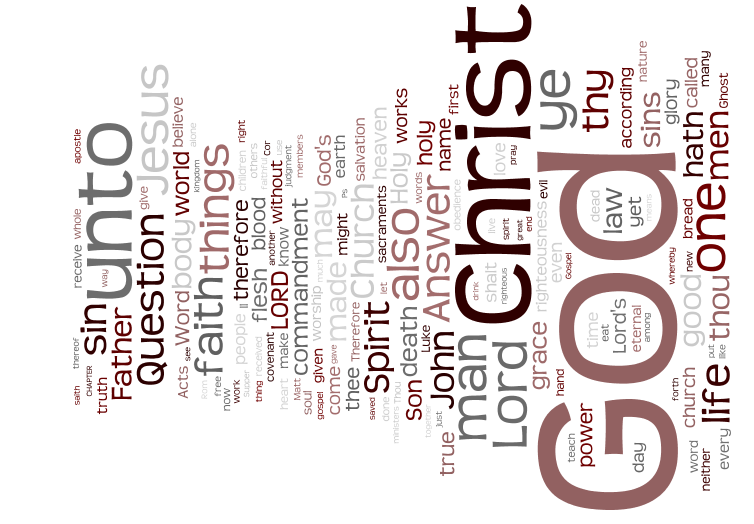
Here, then, is my greatest objection to the Theology Draft: it’s inelegant. It’s a rude instrument for assessing (or even coercing) the “rightness” of faith. It’s full of the language of Reformed theological tradition (see the wordle below) and sentences like, “In his essence, God is infinite, eternal, immutable, impassible, and ineffable.” But it reads like an ordination exam. It reads like something written by someone who’s hand shakes as they write because their disapproving teacher is lurking behind them and peering over their shoulder.

This is how Essential Tenets must read, like traffic citations. And that’s why I don’t like them and don’t want them. But to those in the Fellowship who seek in them a ground of covenantal unity and who will press them into the service of concentrating a self-selected group of Christians into a theological corps bound together by its agreement in faith’s fundamentals essentials, may you find what you seek.

The Fellowship Theology Draft as a wordle

The entire Book of Confessions as a wordle

The Fellowship Polity Draft

The Fellowship of Presbyterians (about whom I’ve written here and here) released drafts yesterday of the polity and theology documents that will guide their January gathering in Orlando. This post will lift up the most prominent characteristics of the polity draft.

I tweeted my highlights of the document on my first read-thru, and you can see those quotes here.

Here’s what the document looks like as a wordle:

Clearly the local congregation is the most important entity in the polity that will shape the Fellowship’s New Reformed Body. Fellowship leaders have said as much, and they’ve been accused of being Congregationalist in their polity. They’re rebutted that claim. At the very least, it’s fair to say that this polity draft establishes that its most important function is to serve the mission and ministry of local congregations.

For comparison’s sake, here’s what the PC (USA)’s Form of Government looks like as a wordle:

Congregation is one of the most prominent polity element there too.

Some of the highlights of what congregations do in this polity:

  • receive, hold, encumber, manage, and hold property: 4.0101(a)
  • prepare required annual review and mission narrative documents for the presbytery: 3.0103(m)
  • request transfer or dismissal from their presbytery or from the New Reformed Body at a called congregational meeting: 1.0503(d)

The other big element in this polity is the presbytery. It defines a presbytery not as a “corporate expression of the church” as in the nFOG of the PC (USA), but as a “covenant community” of congregations. That may seem a pedantic distinction, but I think its significance lies in the fact that, as it does with members of congregations, the Fellowship polity makes voluntary participation in a covenant the substance of participation in a church body.

The presbytery also has a much more active role to play for the Fellowship in the coaching and encouraging of its pastors. The mechanism for this is a peer review process (2.0402) that must be completed at least annually by every installed pastor. The substance of the review is pastors’ health and  future ministry goals, as well as the sharing of best practices and insights.

The controversial stuff about church denominational affiliation pops up in the fifth chapter, titled “Ecumenicity And Union.” What’s described there is a process by which congregations or presbyteries may affiliate with the Fellowship’s New Reformed Body through a union arrangement or by joining a new entity called an Affinity Network. The process laid out requires a 2/3 majority vote of either the congregation or the presbytery respectively, as well as the consenting judgment of the PC(USA) body to which it is currently subject. And in the case where PC(USA) and Fellowship rules butt heads, “the less permissive rules shall govern”(5.0202 and 5.0203).

A few other interesting tidbits:

  1. There’s no General Assembly. The Synod is the highest council in the NRB
  2. Pastors “ordinarily” shall hold an MDiv. degree from an accredited seminary
  3. No CPM: presbyteries come up with their own credentialing and calling mechanism for pastors
  4. Members of congregations are called “Covenant Partners” (see note about presbytery membership above)
  5. Honorably Retired pastors can’t vote at presbytery

Finally, a word about the Essential Tenets. I’ll review those next, but they appear in the polity draft often and they clearly play a unifying role. The Fellowship clearly expects members of churches, congregations, elders, deacons, and pastors to adopt the Essential Tenets they’re laying out, and even to do so “without hesitation” (2.0103c). The lack of a uniform theological standard has been a constant critique of this group, and this polity draft clearly intends to establish the Essential Tenets document as the norm to which everyone must subscribe in order to belong.

Desmond Tutu to The PC (USA): Good Work

One of the prominent arguments against ordaining gay men and women to church office is that the “global church” finds the move unconscionable. Conservatives in America have become enamored of the “global church” of late, often claiming that departing from it in this matter is nothing short of  theological arrogance.
Now, a letter addressed to Gradye Parsons, Stated Clerk of the Presbyterian Church (USA) by none other than Desmond Tutu casts serious doubt on this “global church” position. Tutu is a retired Bishop of the Anglican Church in South Africa and a Nobel Peace Prize winner for his efforts to fight apartheid.  He wrote to Parsons to express his support for the PC (USA)’s recent change to its constitution that will permit gay ordination. Here’s an excerpt:

I realize that among your ecumenical partners, some voices are claiming that you have done the wrong thing, and I know that you rightly value your relationship with Christians in other parts of the world. Sadly, it is not always popular to do justice, but it is always right. People will say that the ones you are now willing to ordain are sinners. I have come to believe, through the reality shared with me by my scientist and medical friends, and confirmed to me by many who are gay, that being gay is not a choice. Like skin color or left-handedness, sexual orientation is just another feature of our diversity as a human family. How wonderful that God has made us with so much diversity, yet all in God’s image! Salvation means being called out of our narrow bonds into a broad place of welcome to all.

That a prominent churchman from another part of the global church community supports the change in ordination standards does not, of course, mean that the issue is settled. Many brothers and sisters across the globe do not support it and find it deeply offensive. But Tutu is an important voice of reason in the conversation. His letter disqualifies blanket appeals to the global church as, in and of themselves, conclusive.

On Singing at Chick-Fil-A

Today we took the junior high group to a local Chick-Fil-A, as promised. They sang their song, ate their chicken, and got a really great welcome from the staff. The manager knew we were coming, so she had prepared this quote to share with us about why Chick-Fil-A is closed on Sunday:

I was not so committed to financial success that I was willing to abandon my principles and priorities. One of the most visible examples of this is our decision to close on Sunday. Our decision to close on Sunday was our way of honoring God and of directing our attention to things that mattered more than our business.

Truett Cathy, Chick-Fil-A founder

A New Culture of Chicken

A few weeks ago I used this video with our junior high mid-week guys group:

(serious hat tip here to The Youth Cartel and their weekly YouTube You Can Use resource for this, which was an entry into a conversation about Sabbath and rest—Chick Fil-A is closed on Sunday).

The following week I caught a few guys singing extended portions of the song. Then they started asking if we could go to Chick Fil-A as a youth group. I made them a deal: come back with a performance of “See You on Monday” and we’d go.

Well today they did just that. This time next week I’ll be gnawin’ on a Char Grilled Chicken Deluxe.

The episode has me thinking about the New Culture of Learning I blogged about back in the spring as I tried to scratch the itch of student motivation; if a New Culture of Learning is about marrying an unlimited information resource with a learner’s intrinsic motivation, how do you surface that motivation?

Um, chicken?

I actually think it’s more than that. This whole encounter has been a platform for these students to do something they think is fun. They actually practiced this, and they employed a certain level of discipline and coordination in pulling it off. I had nothing to do with it.

I’m thinking our trip next week will be an opportunity to continue the conversation about rest and Sabbath, which by now should be a conversation they feel a large ownership stake in.

Is this an overly optimistic way of viewing this?


Monday Morning Quarterback, Senior High Edition

Our High School Youth Group has a new motto:

Follow Jesus or Die.

It emerged from our study of Mark 8:34-36, where I asked them to paraphrase what Jesus is saying. One of our adult leaders offered “Follow Jesus or Die,” and for the rest of the night the phrase was a mantra. I’m not encouraging it, but I’ll give it it’s own legs and see where it goes.

In a telling contrast to the junior high students who thought “deny yourself” meant to do something you’re not supposed to do, the high school students get this. In fact, our study followed an enneagram panel, where four 9’s were given hypothetical situations and asked to respond to them. It gave us an opportunity to talk about self-denial in the interest of peace and group cohesion, since that’s something 9’s are prone to. Healthy 9’s, these authors suggest, learn that self-assertion is not aggression. They begin to stand up for themselves rather than deferring to everyone else as a way to effect the peace they long for.

Would Jesus have us sublimate all of our wants and desires to those of others in every situation? Is it ever okay to assert your will?

One student reported that Jesus’ exhortation to self-denial made her think about her own quest for jazz band supremacy in a new light.

Then someone shouted, “Follow Jesus or Die!”

I’ll take it.

(BTW, thanks to Danielle and Eddie for the enneagram idea)

Monday Morning Quarterback, Session Edition

Something clicked for me at the session meeting last night: much of the ministry at our church is being carried out by highly-committed teams that have only emerged in the last year or so. The commission/committee apparatus is not carrying all of the missional water at our church anymore. A few examples.

  1. Four members of our church have attended a week-long training called Clean Water U to learn how to install a water purification system in communities without clean water. This is part of a presbytery mission initiative in Ayacucho, Peru, and by the end of November, all four of those folks will have been to Peru at least once. Neither of the pastors have been yet.
  2. A stable of almost 10 Godly Play teachers has been leading the Sunday morning children’s program since January. Not only do these teachers lead independently each week, they can often be seen in the Godly Play room during the week practicing for their lessons, and they come to quarterly “confabs,” where they practice upcoming stories and troubleshoot classroom management issues.
  3. A steady group of youth ministry volunteers come each week to help run Sunday School and youth group programming. They also meet regularly to discern the shape of the church’s youth ministry, to plan, and to pray. Five adults went on last summer’s work trip, a sweltering week in south Louisiana.

Each of these teams is supported or overseen in some way by an existing commission. But none of these ministries would be doing the good work they’re doing if the existing business structures of the church were asked to create them. Instead, staff and commission leaders have tried to lay the groundwork and create the conditions where teams of volunteers can emerge to do very specific things in ministry.

The word “do” there is important. These folks are given serious responsibility to lead and make things happen. The word “specific” is also critical. Godly Play teachers may be a bit wary, for example, at the amount of work involved in that role, but it’s clearly communicated, and they’re confident “others tasks as assigned” won’t just pop up.

This observation is reminding me of a distinction between committees, teams, and communities highlighted in an article by George Bullard (and related by Joseph Myers in his book The Search to Belongreviewed by Pomomusings way back in 2003!).  Some quotes from that article:

Committees tend to be elected or appointed in keeping with the bylaws, policies, or polity of congregations.  Teams are recruited or drafted to work on a specific task or set of tasks.  Communities are voluntarily connected in search of genuine and meaningful experiences.

Committees focus on making decisions or setting policies. Teams focus on maturing to the point that they become high task performance groups. Communities add qualitative relationships, meaning, and experiences to the organizations, organisms, or movements to which they are connected

Committees focus on making decisions that are lasting and manage the resources of the congregation efficiently at the best price. Teams focus on debating the strengths and weaknesses of the various choices to complete a task, and typically end up with the highest quality product or outcome. Communities dialogue, engage in discernment activities, and arrive at the best solutions for a particular opportunity or challenge.

Our church has grown a nice little crop of teams. I don’t agree with the title of Bullard’s article, that we need to “skip teams” so that we can “embrace communities” (nor do I think we can “abandon committees” without doing serious damage). I would suspect that in a healthy church organization, all three of those structures are employed to their best ends: committees make decisions and give ongoing oversight, teams effectively carry out important work, and communities connect people to the bigger picture. No one of those instruments is better than the others, per se, only better-suited for the particular thing it’s being employed to do.

I love seeing the teams emerging at our church. Some of them function in some very community-like ways, and all of them benefit from competent committee structures behind them. That seems healthy to me.


Monday Morning Quarterback, Presbytery Edition

Last night, at a called meeting, the Presbytery of San Gabriel adopted a Gracious Dismissal policy. This policy lays out the process that will be followed if one of our member churches ever seeks dismissal to another Reformed denomination. It was drafted at the urging of the 218th General Assembly that presbyteries create such policies in order to demonstrate how they will exercise their constitutional responsibility to “divide, dismiss, or dissolve congregations in consultation with their members.”

A few bullet points about the policy we adopted:

  • It’s a theological document. It sees gracious witness in times of conflict as a missional imperative for congregations and presbyteries alike.
  • It dislikes litigation. The process described seeks to avoid lawsuits over church property and expresses a commitment on the part of the presbytery to not react punitively towards churches seeking dismissal from the denomination
  • It’s a process. When a church seeks dismissal, a presbytery team is assembled to meet with the leadership and the congregation and first seek reconciliation; the congregation elects a special committee to negotiate terms of dismissal with that team, attending to all relevant property issues; those negotiated terms are presented to the congregation at a called meeting for a vote; a 75% or greater vote on the part of the congregation is “validated” by a vote of the presbytery at a stated meeting.

There were several amendments proposed to the policy, all of which made it better in my view and most of which were defeated. An amendment was proposed to strike a clause citing I Corinthians 6:1-11, as in, when churches take each other to court they “violate” said scripture. It was defeated. A subsequent amendment was proposed to truncate the last three verses of that citation, leaving off references to the “Fornicators, idolaters, adulterers, male prostitutes, sodomites, thieves, the greedy, drunkards, revilers, robbers” who won’t inherit the Kingdom of God. It was defeated. An amendment was proposed to add a paragraph guaranteeing a forum for a loyalist minority of whatever size to press its claim to the presbytery that it has the resources and vision to soldier on as a PC(USA) congregation. It was defeated.

Arguments against the policy seemed to be based on an a priori opposition to congregations leaving the PC (USA). I too oppose such situations, but my experience has been that when congregations and their leaders get up a head of steam to do that, it’s much better to have some process in place for the presbytery to respond than to have nothing at all. Whether it’s an Administrative Commission or a non-litigation policy, you’d better have something, because the orchestrations of dismissal typically plunge presbyteries into unchartered waters where the lack of a navigation plan can cause great harm.

I voted for this policy. There are things about it I don’t like, but I think that, for where we are, it’s a serviceable document. I can live with it because, for all of its aversion towards litigation, it does not restrict the right of the presbytery to seek that in a particular case if it deems it necessary.

Thanks to those who worked hard on it, and pray, God, we don’t actually have to use it.


Monday Morning Quarterback, Junior High Edition

When youth groups end on Sunday night my brain is buzzing with critique of what we did and, sometimes, awe at things that happened. It often takes me a few hours to go to bed. So this Sunday night, I’m composing my first “Monday Morning Quarterback” to share with y’all my sense of what went down with our Sunday youth groups and to hear some of your thoughts about it.

For our second week of youth group, there were five 7th or 8th grade students present. That’s five out of nine junior high students on the whole church roster. Three of these students are 7th graders, meaning they’re new to our youth programs. I’m pleased those students have decided the youth programs are worth a shot, but I’m more interested in making it an experience they wish to repeat over the course of the year.

One thing that may help in that pursuit is the Indonesian church that has been meeting in our building on Sunday afternoons since we started youth group. That church is enjoying its fellowship time right next to the youth room at precisely the same time that our students are arriving, and those folks have showered our students with hospitality by urging them to share in the food that has been prepared for their fellowship. So the new church meeting in our building is sharing table fellowship with our students who have grown up in these rooms and corridors; it seems to be a very cool Kingdom of God type thing that is happening.

As for the rest of the time, I continue to structure youth gatherings (and most everything else I have responsibility for) around Moving Beyond Icebreakers: a name exercise, a warmup question, a springboard activity, the work, and a summation. For youth groups, the springboard activity is typically a game, and tonight I caved to the popular demand for Grog (see No. 4 on this list). After the extended meal, the game took us almost to the end of our youth group time, so the work (a quick study of Jesus’ saying about taking up one’s cross) got badly truncated.

Two things I noticed. The warmup question was simply a high point/low point review of the previous week, and the things that count as high points are vastly different for different students. Two boys talked about things they accomplished in the previous week, while another talked about a gift he received, another about a sleepover with a friend, and the fifth about a Friday afternoon spend wrapped in a Snuggie atop a body pillow playing video games.

Also, phrases  like “take up your cross” and “deny yourself” have no meaning to a junior high student, and it’s very, very difficult to explain them. Students thought “deny yourself” meant to do things you know you shouldn’t do. This seems to me to be a demonstration of formal operational thinking struggling to emerge.

Part of the difficulty is my own desire to protect students from a normative description of Christian faith as suffering, so expositions of “take up your cross” like the video below don’t fit the bill. Also, that’s not the norm set by the congregation they live in; the saints of our church are not martyrs. We may need a nudge in that direction, but the point is that our students don’t experience a community of Christians who equate a phrase like “take up your cross” with burden-bearing.


In the end, I suggested that “deny yourself” means going without something so that someone else could benefit. I’m only now realizing the missed opportunity to point to the Indonesian church’s treatment of us as a concrete example of, among other things, self-denial.

Kids started leaving, so I said we’d get into this further next week.

Any suggestions as to how to do that?