Monday Morning Quarterback

Note: Monday Morning Quarterback is a weekly post reviewing Sunday, the busiest, most stressful, most gratifying day in the week of a pastor/parent/spouse/citizen.

 Song of the day:

http://rd.io/x/QEq_KzMpOg/

7:00. Alarm goes off. Yes, 7:00. After daughter’s Halloween party on Saturday and staying up past midnight to finish editing the long overdue movie about our summer vacation, I slept in an hour on Sunday. So defrock me.

7:41. Dressing in black and grey today. I need my colorful socks for a conference I’m attending during the week, for which I’ve been boasting to friends that my socks will “mean business.”

7:44. Breakfast is the bottom half of a leftover Panera bagel from yesterday morning’s gathering of youth ministry volunteers. Chewy.

8:07. Stopping at the grocery store on the way to church. After nearly two months of fall Sundays, I’m finally leading the high school Sunday school class. Yesterday I solicited breakfast requests from several of them by text message, so I’m confidently picking up some muffins and orange juice, impressed with my ability to engage young people in substantive decision making.

8:30. Breakfast spread is ready: mini muffins, mini danish, bananas, and OJ. Snap a photo of it and text to students. This is what they pay me for.

8:38. Setting up the laptop in the sanctuary to show this week’s “Blessings” slide show featuring Erin Dunigan’s pictures when the first student response shakes my phone: “I’ll be there. Nom.”

8:40. Follow up response from same student. “On second thought, I have too much homework.” Another log on the homework bonfire.

8:42. Second student replies to breakfast text. “I’m getting kidnapped this morning so I can’t be there. My mom told you about it.” Rule mom out as kidnapping suspect. I’m gonna miss that kid.

9:02. Standing outside Sunday school classroom with other teachers, waiting for students to arrive. Crickets. (The step son of one of the teachers had recommended the muffins. He’s home sleeping.)

9:03. Text from wife: “we just got up, so we’re not coming to church today.” Reply 😦 I can’t even get my wife to show up.

9:05. Swapping stories with other teachers of high school pranks our “friends” pulled off in high school. The town is abuzz after students from the rival high school painted up our school’s parking lot and littered it with nails.

9:11. First high school student arrives. Cue the victory music.

9:16. Begin Bible study with three adults and one high school student. Trying not to direct every question to the student.

9:32. Bible study is joined by a fourth adult, the leader of the Family Focus Sunday school class. They got one less participant than the high school class.

9:41. Discussion of humility features anecdotes about kidnapped Mexican politicians. High school student looking bewildered.

10:06. Congratulating the congregation on it’s robust support of last week’s Walk for The Hungry. “You guys are great. Uh . . . good job?”

10:18. Children’s Time. CE Director is line-by-line teaching the children a benediction song. Halfway through the second line, with the whole congregation listening intently, CE Director’s infant son lets out an epic rasberry from the first row. It’s at least 15 seconds in length. CE Director losing it.

10:23. Reading today’s Scripture lesson, which is only two verses long. Using a Scottish accent, just to keep it interesting.

11:09. Greeting a young couple on the patio after worship, working hard on that balance between sincere interest and desperation. “Please like us!”

11:32. Congregational meeting to present a preliminary budget, share stewardship goals, and elect officers. And to eat crunchy Asian salad. Seconding the motion for more of the salad (see what I did there?).

11:37. Church member with whom I had a phone conversation earlier in the week follows up with a typed letter, handing it to me between bites of salad before leaving for another engagement. Fold the letter and put it in my pocket, wondering if it will end up in the laundry.

12:02. Talking with a church member who read my ECO blog post earlier in the week and who worshiped last weekend at one of the angry Presbyterian churches. “They say ‘savior’ a lot,” he observes. “That’s a word we hardly use here ever.” Respond by narrating a brief history of American evangelicalism, then stop, deciding once again that I care less about explaining the differences between evangelicalism and our church than I do about doing church really, really well. Then wonder if that decision is worth anything.

12:15. Return home to help put the house back together after yesterday’s party (our condo is small enough that having company requires stuffing the living room into the garage, like kids cleaning their room by hiding clothes and toys under their bed.)

12:17. Changing my clothes and remembering to take the church member’s letter out of my slacks pocket and place it in the pocket of my shorts. Again wondering if it will find the laundry.

12:18. Texting youth group students, trolling for snack volunteers for this afternoon’s youth groups. “First one to reply wins.”

12:19. We have a winner. This is what they pay me for.

12:20. Wife offers untouched pie from yesterday’s party to the youth groups. Seriously? Where were you three minutes ago?

12:52. Having regained access to the garage, cleaning cat’s litter box and assessing my experiment at using an old Diaper Champ as a dirty kitty litter bin. It works great, until you lift a week’s worth of litter out of the bin and rip the bag open, spilling Hell’s belly all over the floor.

2:30. Wife napping. Trying to convince Daughter to do a grocery store run with me. Nope.

2:36. Finalizing vacation movie instead and uploading to Vimeo.

2:41. Daughter notices bag by the door, a bag filled with items for the Goodwill, items including some of Daughter’s things she hasn’t played with in forever. Uh oh. “These are my faaaavorite!” Daughter wails. Trying to argue that if they really were her favorite she would have noticed them missing before she spied them in the bag is a loser’s errand.

2:44. Wife intercedes in GoodwillGate from upstairs, ruling that Daughter can keep the items. Daughter wins, but is playing the hurt to the hilt, burying her face in the carpet and moaning.

2:46. Turning on a movie. Not only has Daughter saved her excess toys from making other children happy, now she’s enjoying a victory lap of The Smurfs.

3:43. Getting ready to leave for youth groups, making wife some post-nap coffee. She reminds me, “Don’t forget the pie.” Don’t forget the pie? C’mon, man. I got this.

3:57. On my way out the door to youth groups, grab the bag with Daughter’s ransomed toys, looking back over my shoulder to see if she noticed. She didn’t. I’m a monster, I know.

4:01. Halfway to the church before I realize I forgot the pie.

4:42. Snap a junior high student’s three game Connect Four winning streak. Debut my victory dance to blank stares.

4:57. Leading junior high students in writing acrostic poems with the word E-V-I-L. Winner: Every Venomous Intention Loses. Student next to me can’t get over the fact that he can use both “elephant” and “virgin” in the same composition.

5:38. Playing Grog. A student has brought his costume for this: black robe and silver skeleton mask. Notice that the boys scream like frightened toddlers when chased. The girls seem bored. Constructing an anthropological theory in my head about adolescent boys’ delight in danger.

5:57. Winning snack volunteer has brought chips and a dip she claims is her grandmother’s secret recipe. Swallow the claim with gusto, along with most of the dip.

6:01. Music Director debuting a new youth program tonight, which I’ve dubbed “The Youth Music Thing.” Good initial turnout. I’ve got a pie at home, though, so . . .

6:23. Return to Youth Music Thing with pie to discover that, in my absence, students have convinced the Music Director–sound unheard,–that their first project should be a music video of The Aquabats’ “Hey Homies!” They’re over the moon when I walk in because they know I have this on my iPod.

6:25. Student demonstrates the “360 Hug” by lifting me up and spinning me around. After, he collapses on a couch in pain and yells, “Why are you so fat?!” Use the last piece of pizza to stifle my tears.

7:01. Youth Intern arrives with a Grande Coffee for me. Cry on his shoulder a little bit.

7:24. German foreign exchange student stymies the high school youth group when he shares that the thing that made him happy this week was the realization that he’s smarter than everybody else in his math class. Awkward laughter. American youth really don’t know what to do with this kind of hubris.

8:12. Youth Intern leading a very thoughtful conversation on the problem of evil in which all of the students are eagerly and respectfully contributing. I’m tracing the coffee stain on the side of my cup with a pen.

8:39. Playing Grog. Again. There should be a seminary class on the proper technique for jumping out from behind a sanctuary door to scare the bejeesus out of a student. Also, I should teach that class.

8:53. Somebody keeps crop dusting the front of the sanctuary during the game. Invent a joke: “Eww, somebody Grogged.” Nothin’.

9:02. There are two slices of pie left and they’re coming home with me. They will compliment my fat pizza nicely.

9:30. First order of business upon returning home is to grab the torrent of tonight’s episode of The Walking Dead. Second order of business is to pull up the archive of this afternoon’s Broncos’ game. Business getting done.

10:11. Daughter comes downstairs. “Daddy, Mommy said to come down and have you get me a snack.” Pick her up and hold her for a bit before getting her some chips and warm milk, which I tell her my dad used to make for me when I couldn’t sleep (at least once he did). She’s delirious to be part of a family tradition.

10:14. Daughter explaining that she watched a video with Mommy that scared her. It was a Bible video, she says, about David, who got sent to the scary forest where there was lots of lava. Probably Apocryphal.

10:17. Suggest that I take Daughter to her bed. “No Daddy, I can go by myself.” Great. Follow her to the stairs. “No, Daddy, you don’t need to come with me.” Watch her take two steps up the stairs. “Daddy, don’t follow me. Really. Don’t.” She reaches the top of the stairs and sprints to Mommy and Daddy’s bed, where she announces to her sleeping mother, “Daddy made me warm milk like Grandpa used to make for him!” So much for a sleep aid.

11:09. Broncos’ game finished. Putting off Monday Morning Quarterback til the morning. Head to bed with the church member’s letter still in my pocket.

Playing My iPod at Youth Group: Lessons in Participatory Learning

The 7th and 8th graders I work with can’t leave my iPod alone. I play it to add to the atmosphere–relaxed, welcoming, familiar. But it takes mere seconds before one of them–and then several of them–are fiddling with it: switching songs, turning up the volume, and then finally plugging in their own music player.

Yesterday I had a “Back-in-My-Day” moment over this and exclaimed, “When I was your age, if someone played some music, you listened to it. You couldn’t just hijack what they were playing for your own music.” Actually, when I was their age we did take control of the music people played in public, only by changing the radio dial. Your frequency of choice was an important marker of identity in my teen years, and any car outing I take with students shows that it still is.

But this is way different. These students have entire radio stations in their pockets, and it’s nothing for them to plug it in and dj the youth group. That is, until someone else takes over. Honestly, the likelihood that any one song will get played in its entirety is very, very low.

I want to celebrate this and to say that these junior high students are comfortable taking control of their experience (read: church) without waiting for instructions. But I don’t see this tendency extending very far beyond the iPod. Ask them what questions they’d like to explore in youth group and you get blank stares. Invite them to take some ownership of the Biblical narrative–to rework stories or to pick and choose content for study–and . . . nothing.

What’s up with that?

Does their musical mastery presage something constructive? Or is it simply a loyal consumer reflex?


Ownership: The Annual Youth Retreat Post

2013-03-23 20.09.48

Last weekend was the annual youth retreat run by our regional camp and conference center. This was the third one I’ve taken students to (read my posts about the first two retreats here and here). After wrestling with the message and the atmospherics of these retreats for two years, this year I was much more focused on the mechanics of who was in charge and how they related to my students.

The Director of this year’s camp was returning from last year, and he was just as impressive. He’s energetic without being silly, thoughtful without being professorial, and in control without yelling. The unifying theme he prepared and the graphic that tied it together all weekend was relevant and interesting. Seriously, I’m a fan.

The thing I appreciate most about this retreat, like the last one, is the self-directed nature of what students are asked to do. There’s a central Biblical text driving the weekend, but smaller cabin groups led by adult counselors take ownership of a small part of that text in order to explore it with depth and then share their learning with all their peers.

[The unifying text was Colossians 3:12-14. My cabin group (8th-11th grade boys) chose to wrestle with “meekness.” Think about that for a minute.

What they found and shared will certainly stick closer to them than anything any speaker could have told them. Of that I’m confident.]

It’s the students’ ownership of their own learning at these retreats that is producing my one nagging . . . critique? The substance of it is this: as a person with a high level of ownership in my relationships with these students, I want more ownership of their retreat experience.

Tell me if this is bad. It suddenly feels off to me that the people pulling the levers of the retreat experience are young adult youth workers and musicians who don’t know the students–mostly (many of the students have been to the retreat or to summer camp before). They don’t know them at the start of the weekend, and since the heavy small group lifting is born by small group leaders (the students’ pastors and youth leaders), they don’t really get to know them by the retreat’s end.

Here’s what I’m feeling: it would be a good move to either involve more of the pastors and youth leaders from the churches sending students in the conception and planning of the retreat. It would also be a good move to structure the event to force more interaction between youth and these dynamic, smart, compelling young adult leaders.

Retreats are a valuable supplement to my Christian formation program. I want my students taught by people other than me. I want them interacting with peers from far away. Part of my un-ease feels like a lost opportunity–either for my kids to really get to know the paid staff leaders or for their pastors to inform more of what they do at the retreat.

What do you think? Which is more valuable: the exposure to new adult teachers and leaders or a program designed by the people who know students best?


Monday Morning Quarterback

Note: Monday Morning Quarterback is a weekly post reviewing Sunday, the busiest, most stressful, most gratifying day in the week of a pastor/parent/spouse/citizen

Song of the day:


 6:13. Get out of bed couch as house guest opens the front door, thunking it against the latched security chain and cursing, on his way to Starbucks to finish the morning’s sermon (house guest is also the guest preacher for the day). Threaten to beat him senseless (house guest is also a close personal friend).

6:15. Fire up the computer to the cold reminder that the Broncos blew their playoff game the day before. Wonder: if losing in the divisional round is all the same, wasn’t it more fun with Tebow?

6:17. Decide I’m over football.

6:57. Put the finishing touches on the youth group outlines for later in the afternoon. High school outline consists only of “Check In (possibly by student),” “Game,” “Bible.” Oddly, calm.

7:33. House guest returns and we leave for church, I in a snazzy purple shirt and tie I got for Christmas. Also, my new tie pin.

8:12. Return home with house guest to retrieve his preaching robe. Carry it to the car like Mr. Bates. Insist on the correct pronunciation of “Valet” for the rest of the day.


9:04. Introduce house guest to adult Sunday School class, listing all of his credentials except his 13 year tenure as a church pastor. Next time . . .

9:13. Watch house guest lead class on the inclusion of LGBTQ people in the church. Savor the sudden realization that all is well: my friend is doing God’s work out in the open without fear.

9:48. Joke with Head of Staff that house guest packed three white stoles and needs help choosing one. She puts on hers, a white-with-green-patterned one she got in Jerusalem. Joke: “Good choice. Surely [house guest] doesn’t have one like that.”

9:52. Advise house guest to wear the white-with-red-patterned stole he got in Jerusalem.

9:58. Insist that the acolytes wear white cinctures instead of the green they’ve donned. For Heaven’s sake, it’s Baptism of The Lord.

10:16. Enlist house guest in Children’s Time, sliding baptismal font halfway across the chancel like an old couch. Tell kids we do “some things” with the font, then correct myself, “Well, we really only do one thing with it.” Decide to push it a step further: “youth group games notwithstanding.” Stop. Just stop.

10:42. Listen to house guest bring the Word.

12:34. Finish lunch as another football game is finishing. Note that earlier decision to be over football was foolish.

1:38. Text from student: “if someone were to throw the baptismal font and accidentally break it…how much would it cost to replace?” Resolve to can joking during Children’s Time. Delighted, though, that students were there and paying attention.

3:01. Bid goodbye to house guest. Make plan to stew in sadness for the rest of the afternoon.

3:30. Get to work on jar salads. Allow 4 year-old to assemble two of them (mom will get those ones). Vegetables chopped, dressing made, and 10 salads done in an hour. Clean up not so much.

4:43. Discover I’ve come to jr. high youth group without my lesson plan. Deputize staff volunteer to lead youth group.

4:53. Students share uniformly that their favorite thing about church is youth group and their least favorite thing about church is worship. Wonder what to do about that.

5:22. Marvel at the commitment and skill of youth group volunteers.

7:18. High School student announces, “It’s not littering if you don’t throw it!” Must write that down.

8:41. Lead lectio divina with Isaiah 43. Glory. Precious. Honor.

9:23. Back home, put 4 year-old in bed to loud protestations, listen to her scream for 37 minutes before falling asleep.

10:12. Decide I’m over football.


In Which A World-Renowned Theologian Says Exactly What I Was Thinking

Review of last week:

Posted this on Monday, asking, “Where are the adults in our young peoples’ lives who care about them for their own sake and not for some alterior, career-advancing motive?”

Went to the Emergent Theological Conversation on Wednesday to hear the likes of Tripp Fuller, Philip Clayton, and John Cobb talk about process theology. Clayton I found particularly compelling.Bought Kindle version of Clayton’s latest book, “The Predicament of Belief,” in which I discovered this quote while reading on Thursday:

One cannot assume, after all, that the mere fact of an agent’s taking an interest in the existence of other beings is morally admirable, even if it entails a certain amount of self-limitation on that agent’s part. One thinks of numerous mundane analogs: the farmer who shows concern for the well-being of his livestock only for the sake of maximizing his own financial gain; the would-be father who works long hours so he can start a family but who mainly wants children out of loneliness or for any of a host of social or cultural reasons; the teacher who pours her life into the minds of her students because she sees them as a way of establishing her career and exerting influence over the future of her profession. The motives involved in each of these cases are not obviously evil and do not involve any sort of deception; but neither are they altruistic.

Thought, “Hmmmm.”

Wondered if I could get Philip Clayton to be a volunteer leader of my youth group.

When Theater and Volleyball Collide: Some Thoughts on The Pressures Facing Youth Facing Adults

A high school student participates in theater and volleyball. During the same week, she has both dress rehearsals and three performances of the theater production and two volleyball games. Something has to give.

The student approaches the theater director and asks permission to miss a rehearsal in favor of the volleyball game.

“Absolutely not. The production needs you. You’ve had the production schedule for eight weeks. You must be at all of the rehearsals or your theater grade will be docked an entire letter.”

Discouraged, the student approaches her volleyball coach. May she, she asks, miss one of the week’s two games in favor of the theater production?

“What? Of course not. You’re a starter and a leader on this team. You’ve known our schedule since the start of the season, and you know the rule: miss a practice and you’re benched for a week. Miss a game and it’s two weeks. The choice is yours.”

The volleyball coach and the theater teacher never speak to each other about the student.

Our high school youth group has been talking about pressure: peer pressure, academic pressure, social pressure. High school students today are under an immense load of pressure, and I’ve noticed that this pressure is placed upon them by adults who are themselves feeling the heat of high expectations.

The teachers need to produce students who test and perform at a high level to meet rising standards of standardized test scores and artistic achievement, and coaches need to produce winning teams that play at a high level to justify their positions or get promoted to better ones.

Where, in this ecosystem, are the adults who relate to these teenagers as something other than as lines on a resume? Where are the adults who care about these students as people, who’s livelyhood doesn’t depend on the students’ performance?

Am I, a pastor to these youth, making objects of them in much the same way? Does my sense of success as a minister depend upon their attendance at youth programs? When they blow off youth group because they have six hours of homework, does my annoyance evidence traces of the same fear-based use of them for my own professional security?

How much of the landscape of youth performance and achievement, including at church, dehumanizes young people for the sake of adults’ survival?

On Singing at Chick-Fil-A

Today we took the junior high group to a local Chick-Fil-A, as promised. They sang their song, ate their chicken, and got a really great welcome from the staff. The manager knew we were coming, so she had prepared this quote to share with us about why Chick-Fil-A is closed on Sunday:

I was not so committed to financial success that I was willing to abandon my principles and priorities. One of the most visible examples of this is our decision to close on Sunday. Our decision to close on Sunday was our way of honoring God and of directing our attention to things that mattered more than our business.

Truett Cathy, Chick-Fil-A founder

A New Culture of Chicken

A few weeks ago I used this video with our junior high mid-week guys group:

(serious hat tip here to The Youth Cartel and their weekly YouTube You Can Use resource for this, which was an entry into a conversation about Sabbath and rest—Chick Fil-A is closed on Sunday).

The following week I caught a few guys singing extended portions of the song. Then they started asking if we could go to Chick Fil-A as a youth group. I made them a deal: come back with a performance of “See You on Monday” and we’d go.

Well today they did just that. This time next week I’ll be gnawin’ on a Char Grilled Chicken Deluxe.

The episode has me thinking about the New Culture of Learning I blogged about back in the spring as I tried to scratch the itch of student motivation; if a New Culture of Learning is about marrying an unlimited information resource with a learner’s intrinsic motivation, how do you surface that motivation?

Um, chicken?

I actually think it’s more than that. This whole encounter has been a platform for these students to do something they think is fun. They actually practiced this, and they employed a certain level of discipline and coordination in pulling it off. I had nothing to do with it.

I’m thinking our trip next week will be an opportunity to continue the conversation about rest and Sabbath, which by now should be a conversation they feel a large ownership stake in.

Is this an overly optimistic way of viewing this?


Monday Morning Quarterback, Senior High Edition

Our High School Youth Group has a new motto:

Follow Jesus or Die.

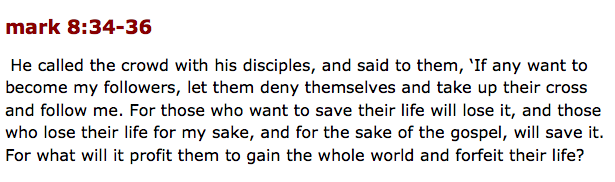
It emerged from our study of Mark 8:34-36, where I asked them to paraphrase what Jesus is saying. One of our adult leaders offered “Follow Jesus or Die,” and for the rest of the night the phrase was a mantra. I’m not encouraging it, but I’ll give it it’s own legs and see where it goes.

In a telling contrast to the junior high students who thought “deny yourself” meant to do something you’re not supposed to do, the high school students get this. In fact, our study followed an enneagram panel, where four 9’s were given hypothetical situations and asked to respond to them. It gave us an opportunity to talk about self-denial in the interest of peace and group cohesion, since that’s something 9’s are prone to. Healthy 9’s, these authors suggest, learn that self-assertion is not aggression. They begin to stand up for themselves rather than deferring to everyone else as a way to effect the peace they long for.

Would Jesus have us sublimate all of our wants and desires to those of others in every situation? Is it ever okay to assert your will?

One student reported that Jesus’ exhortation to self-denial made her think about her own quest for jazz band supremacy in a new light.

Then someone shouted, “Follow Jesus or Die!”

I’ll take it.

(BTW, thanks to Danielle and Eddie for the enneagram idea)

Monday Morning Quarterback, Session Edition

Something clicked for me at the session meeting last night: much of the ministry at our church is being carried out by highly-committed teams that have only emerged in the last year or so. The commission/committee apparatus is not carrying all of the missional water at our church anymore. A few examples.

  1. Four members of our church have attended a week-long training called Clean Water U to learn how to install a water purification system in communities without clean water. This is part of a presbytery mission initiative in Ayacucho, Peru, and by the end of November, all four of those folks will have been to Peru at least once. Neither of the pastors have been yet.
  2. A stable of almost 10 Godly Play teachers has been leading the Sunday morning children’s program since January. Not only do these teachers lead independently each week, they can often be seen in the Godly Play room during the week practicing for their lessons, and they come to quarterly “confabs,” where they practice upcoming stories and troubleshoot classroom management issues.
  3. A steady group of youth ministry volunteers come each week to help run Sunday School and youth group programming. They also meet regularly to discern the shape of the church’s youth ministry, to plan, and to pray. Five adults went on last summer’s work trip, a sweltering week in south Louisiana.

Each of these teams is supported or overseen in some way by an existing commission. But none of these ministries would be doing the good work they’re doing if the existing business structures of the church were asked to create them. Instead, staff and commission leaders have tried to lay the groundwork and create the conditions where teams of volunteers can emerge to do very specific things in ministry.

The word “do” there is important. These folks are given serious responsibility to lead and make things happen. The word “specific” is also critical. Godly Play teachers may be a bit wary, for example, at the amount of work involved in that role, but it’s clearly communicated, and they’re confident “others tasks as assigned” won’t just pop up.

This observation is reminding me of a distinction between committees, teams, and communities highlighted in an article by George Bullard (and related by Joseph Myers in his book The Search to Belongreviewed by Pomomusings way back in 2003!).  Some quotes from that article:

Committees tend to be elected or appointed in keeping with the bylaws, policies, or polity of congregations.  Teams are recruited or drafted to work on a specific task or set of tasks.  Communities are voluntarily connected in search of genuine and meaningful experiences.

Committees focus on making decisions or setting policies. Teams focus on maturing to the point that they become high task performance groups. Communities add qualitative relationships, meaning, and experiences to the organizations, organisms, or movements to which they are connected

Committees focus on making decisions that are lasting and manage the resources of the congregation efficiently at the best price. Teams focus on debating the strengths and weaknesses of the various choices to complete a task, and typically end up with the highest quality product or outcome. Communities dialogue, engage in discernment activities, and arrive at the best solutions for a particular opportunity or challenge.

Our church has grown a nice little crop of teams. I don’t agree with the title of Bullard’s article, that we need to “skip teams” so that we can “embrace communities” (nor do I think we can “abandon committees” without doing serious damage). I would suspect that in a healthy church organization, all three of those structures are employed to their best ends: committees make decisions and give ongoing oversight, teams effectively carry out important work, and communities connect people to the bigger picture. No one of those instruments is better than the others, per se, only better-suited for the particular thing it’s being employed to do.

I love seeing the teams emerging at our church. Some of them function in some very community-like ways, and all of them benefit from competent committee structures behind them. That seems healthy to me.