
When we get home after 8:00, I want to exercise.
Laura wants to make cookies.
Cookies win.
Again.
When we get home after 8:00, I want to exercise.
Laura wants to make cookies.
Cookies win.
Again.
Everybody has permission to raise issues. The font is too small. The language is too vague. The language is too restrictive. The decision doesn’t seem right.
Everybody also has permission to propose solutions, though. The proposed edit or addition adds value to the raised issue. More than, “This should be different,” it says, “This should be this.” It puts a specific choice on the table for people to discuss.
You have permission to propose solutions. They don’t have to be perfect. They don’t even have to be right; a wrong proposal still moves us closer to a right one. Your proposal just needs to be specific, and it needs to be yours.
Share it. Own it.
Noah sent the dove out three times seeking for signs of life. The first time, nothing. The second, the hopeful olive leaf. The third time, the bird is gone: the surest sign.
Of course, it’s rarely sequential like this. The olive leaf is just as often followed by nothing as it is by the sure sign we want to see. It’s not really faith if it follows a set progression.
We moved over the weekend. Because there’s not enough disruption in the world, my family and I decided to spend weeks packing up all our belongings and trucking them about four miles down the road to a different domicile. Today is the first “real” day in the new place–first day back to work, first day to make coffee, first day for all the firsts, only done in a way that the reigning set of local and global circumstances is contorting. For example, when the day comes that I commute to work, that, too, will be new, from here.
The new keeps coming, and boy is it a strain. A hopeful orientation interprets the stain as labor pains and chooses to find new birth in all the disruption, but in order for that to be truly hopeful and not mere optimism or sentimentality, I think we have to reckon with the strain. Birth is overpowering strain, both for the birther and the birthed. There is joy in the strain, but also danger, and at the intersection of the two is the miracle of new life.
Now push.
This week Seth Godin shared an audio recording of “Letter from A Birmingham Jail.” A couple dozen voices contribute to a pretty arresting audio product, and I’ll post it below for you to listen.
One thing I noticed listening to it while driving around yesterday afternoon is this segment about “outside agitators” from very early in the letter. It contains perhaps the best known sentence of the entire text, but, given–as we have recently seen–the persistent impulse of those defending the status quo to vilify demonstrators as outsiders, the whole paragraph made me stop and take careful note:
Moreover, I am cognizant of the interrelatedness of all communities and states. I cannot sit idly by in Atlanta and not be concerned about what happens in Birmingham. Injustice anywhere is a threat to justice everywhere. We are caught in an inescapable network of mutuality, tied in a single garment of destiny. Whatever affects one directly, affects all indirectly. Never again can we afford to live with the narrow, provincial “outside agitator” idea. Anyone who lives inside the United States can never be considered an outsider anywhere within its bounds.
Reporting showed that most of the people arrested during demonstrations in Minneapolis, for example, lived there. The Mayor and the President were wrong in saying that most of the protestors’ energy came from outside the community they were protesting. But even if they were, that, by itself, is not a disqualifier.
“Check your privilege” is a stupid slogan, because “check” is a meaningless verb unless it is applied to a hockey player, a sound technician, or an anxious person worried they left the iron plugged in. Last weekend I saw a person, a white person, carrying a sign at a Black Lives Matter demonstration in our majority white Northside Chicago neighorhood, holding a sign that read: “White people, listen: check your privilege.” I recoiled. This person must have done a lot of personal privilege-checking to feel comfortable instructing thousands of strangers to do the same, strangers who mostly look like her and live in the neighborhood she lives in, which, due to redlining, has historically excluded black people from home ownership.
Privilege needs more than checked. It needs forfeited, and that won’t happen without a fight. That won’t fit on a sign.
The instructions for the photo scavenger hunt were on all the junior high kids’ screens, shared using a Zoom function I’ve employed weekly since March with no difficulty. But a smudge appeared on the screen, and then another. I asked my co-leader if she saw it. She did. As if granted permission, then, the smudge spread out over the entire slide as a dark scribble, obscuring the instructions from view.
Clearly, somebody was hijacking the slide. “How is that happening?” I asked. One student replied in the chat: “Must be a glitch.”
Uh huh.
I suddenly recalled this experience from 2014:
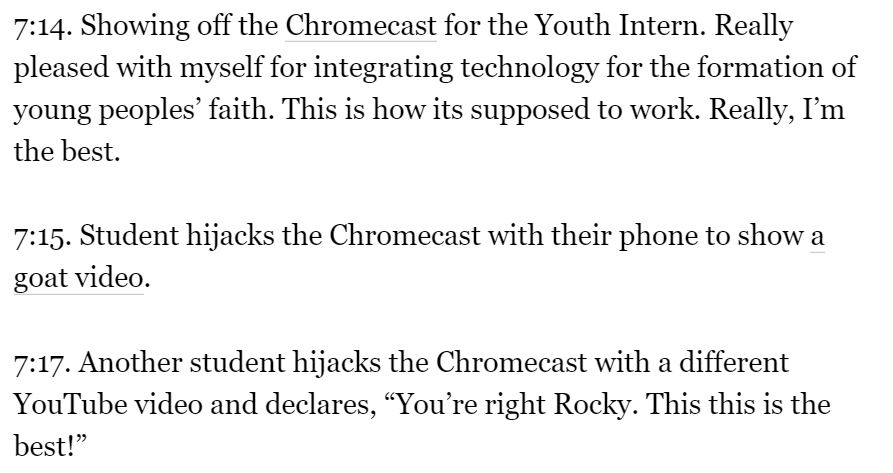
They’re always ahead of me on the technology.
You’re a hypocrite. You profess conviction about things in public that your private decisions undermine, often unconsciously, sometimes with a wincing, shoulder-shrugging acknowledgement, and, on certain very rare occasions, with bald complicity.
Authenticity is important, and we should be moving every day in the direction of congruence between what we say and how we actually live. Phonies are intolerable.
Black Lives Matter. Say it. Put it on a sign and take it to the street. The moment you do so you expose your hypocrisy and open yourself up to interrogation by the Phonie Finders and the Whatabouts. They, threatened and uncomfortable, will point out your complicity in perpetuating white supremacy and your cozy coexistence with racism, and they will be right.
Say it anyway. Public failure is a useful inoculation against inaction. Plus, consider the source: how much do you care about the critique of those who aren’t even trying?
Say it anyway. Self-aware hypocrisy is more useful than the smug silence of the self-satisfied. The self-aware own the chasm between their words and their actions, and they work to shrink it. That’s productive; the chasm will never completely close and there will forever be more to do. The self-satisfied avoid the chasm by saying nothing, protecting themselves from accusation. Good for them, bad for everyone else.
Black Lives Matter. Say it. Speaking truth has a way of changing more than your mouth.
This feeling of uncertainty and not knowing the right thing to do is good. For those of us who accustomed to the comfort of clear expectations and uncontested boundaries, the moment when the boundaries are questioned and the expectations upended is very disorienting. We probably need that. Not only because we need to heighten our awareness of all the people who have those expectations foisted upon them and the boundaries enforced, physically and economically, but also because we won’t grow if we’re always comfortable.
Take heart: tension contains possibility.
The time to act is now, because the building is burning and lives are at stake now. Not for the first time, now, but definitely now. Lots of nuanced deliberation is not the order of this day. We need to move.
And keep moving.
A fire doesn’t ask you what you think you should do. The action it requires is urgent and obvious. But urgency will fade as the flames subside to a simmer and the crowds disburse and people begin to talk about something else. What will we be doing then to douse those scorching embers that are still burning? That matters just as much as the things we’re doing now, when the flames demand attention.
 YoRocko!