A Homeless Woman Prayed for Me Today

A woman spends nights atop the concrete bench on our church patio sometimes, covered by a blanket and attended by a suitcase that holds all her possessions. She’s frequently in worship, and both our pastoral and our administrative staff have worked with her to find a housing solution, without success. We’ve run up against our limits in helping someone for whom housing is only one of a host of difficulties she’s battling.

This morning she’s in my local Starbucks. I greet her from the queue as she heads for the restroom, then, after I’m seated with my Christmas Blend, she stops by my table on her way out. She notices the eczema flaring up on my wrists and arms and asks about it. Self-conscious, embarrassed, I explain that I’ve dealt with it my whole life and that it gets worse in the winter. It’s no big deal.

Except that it is. Over the past three weeks I’ve spent who-knows-how-much on creams and lotions to calm this latest flare up. After writing this post I plan to check on refills for my steroid cream. It’s maddening. I’m losing sleep over it.

She offers to pray for me. I gladly thank her and turn back to my screen.

“Now,” she says, and without another word, she’s kneeling by my side and covers my wrists with her hands and praying for God to heal my eczema.

No one has ever done that for me before. Heck, I’ve never prayed about my eczema before.

I thank her as earnestly as I can as she heads for the door. Then she unexpectedly returns to my table to implore me to tell her what happens with my eczema. “You know what’s going to happen,” she says.

I don’t know how to share with her my hunch that a healing thing has already happened.
I’m Done Agreeing To Disagree About Assault Weapons

I’m struggling with what, if anything, to say about yesterday’s shooting here in California, that will be constructive.

Yeah, struggling.

Back in 2007, after the Virginia Tech shooting, I wrote on my old blog:

“Guns don’t kill people; people kill people.” What other industry, what other lobby, what other interest would be allowed to simply explain away the cause of killing so glibly without some kind of public outcry or legislative avalanche? What other product has to defend itself against the connection between itself and lots and lots of killing?

Nearly nine intervening years and–God help us–countless mass shootings later, we still don’t have satisfactory answers to those questions.

I belong to the Reformed branch of Protestant Christianity, which has always been characterized by a unashamed engagement in public life in pursuit of Biblically-inspired goals like care for the poor, justice, and equality, without the concurrent aim of imposing Christian mores on the society as a whole. The Reformed tradition has always seemed to me like a middle ground between withdrawal into a pietistic enclave and working for a “Christian” culture.

That’s context for this: allowing citizens to purchase assault rifles makes our public life less safe, and the insistence upon that right as inalienable is literally killing us. This is no longer a subject about which people of good will can disagree. If daily mass shootings are a price you’re willing to pay to ensure that citizens can purchase assault weapons unobstructed, you’re not a person of good will.

Seriously, an Assault Weapons Ban has to be a non-starter at this point. If you’re opposed to that, I don’t see what common ground we have. Agreeing to disagreeing is allowing more people to die. I won’t do it anymore.

Communion Is Better Than Community Is Better Than Affinity

I’ve suggested that affinity is not the same thing as community, that community is harder to build, and that therefore community is a better goal for youth ministry (indeed, for all ministry).

But there’s a theological dog not barking in those assertions. Church life holds forth an invitation to something greater than both community and affinity: communion.

Communion is unity that can’t be manufactured or organized or planned, because it’s a work of the Spirit. Liturgically, it happens around the table where one bread, one body, one cup are shared. But it’s happening in non-liturgical ways as well, as God knits men, women, and children together who have no business with one another–politically, culturally, racially, or economically.

We can build community. Only God can build communion.

But maybe by tending to the conditions that make for strong community we co-build communion with God.

Affinity or Community

Doublas Rushkoff made a prescient observation in an opinion piece about Donald Trump for Digital Trends yesterday, but instead of Trump it has me thinking about youth group. Here’s the observation:

Digital media, on the other hand, is all about choice and boundaries. We don’t have communities so much as affinity groups. We choose evermore specific sets of connections and feeds of information – and if we don’t, Facebook’s algorithms will do it for us. Your Google search is different than my Google search, because the company’s algorithms know how to parse what is different about our predilections.

I’ve been a big advocate of an “affinity-based” youth ministry approach over the past three years. My enthusiasm for it stems from my reading of Youth Ministry 3.0 and my interactions with the author, Mark Oestreicher, through of of his organization’s Youth Ministry Coaching Program cohorts.

One of Marko’s keen insights is that adolescent development has a lot more to do with finding affinity today than it did in previous iterations of youth culture, when you were either “in” or “out,” you belonged or you didn’t. Humans almost always seek out belonging, and that search is particularly urgent in adolescence. What’s important to note is that, in the Google and Facebook world Rushkoff is pointing to, “It’s easier to find a place to belong,” as Marko observes.

So I have focused a lot of my youth ministry efforts on working within groups where teens already have some affinity with one another. The best example is these weekly after school groups of youth who come as a group. They are one another’s people already, and they’re together when they’re not at church. At church, we do something different.

I’ve focused a lot less effort on building community among divergent affinity groups or among teenagers on the margins who don’t feel like there is a group for them. Rushkoff’s assessment stings a little bit and makes me want youth ministry to model a different way.

Affinity is not the same as community. Community is harder.


A Whole Meeting With No Phone

I borrowed Sherry Turkle’s latest book from the library last month and got about 2/3 of it read before I had to return it yesterday. It’s arguing that digital communication technologies inhibit the creativity that can only come from face-to-face, analog communication. It’s a long unpacking of Douglas Rushkoff’s insight that digital media are biased toward connecting people across great distances but biased against connecting people who are sharing the same space.

So I’m keeping my phone off the table at meetings and meals. Yesterday I sat in a project meeting for over two hours with five other people working, and I took my phone out only to check calendar dates relevant to our project.

I was more engaged in that meeting than I’m typically able to be. Of course, the urge to check or send an email occurred to me. Of course I considered tweeting something prescient someone had said. Of course Facebook and Messenger made frequent appearances in my consciousness.

But (mostly) I told them all “No,” and the benefit was clear to me. Creative possibilities got proposed, mulled over carefully, expanded, revised, adopted, and planned. It was interesting and it was fun. Those two hours of focused engagement fueled the rest of my day.

My laptop and phone are not the enemy of my work. Turkle is making a case, though, that in-person conversation is a stronger ally of our work by far, and that defaulting to electronic tools for communication is diminishing both our work and our enjoyment of doing it.

Not everybody’s buying it. Jonathan Franzen:

When she notes that Steve Jobs forbade tablets and smartphones at the dinner table and encouraged his family to talk about books and history, or when she cites Mozart, Kafka and Picasso on the value of undistracted solitude, she’s describing the habits of highly effective people.

After yesterday, though, I’m saying score one for Turkle.


Monday Morning Quarterback

The chancel lights aren’t working.

The candle holders on the Advent wreath are wobbly and can’t be tightened because the screws are stripped. They’ve been stripped for three years at least, yet another late November Sunday finds us surprised, stuffing bits of paper towel down the sides of the candle cups to try and stabilize them.

The crew renovating the meeting room left all of their equipment–ladders, a Shop Vac, light fixtures, blinds, and–no joke–a large traffic cone–in the youth room. There’s a Sunday school class in here in 20 minutes, yet the place looks like a construction site.

There’s one student at the Sunday school class.

The Fellowship Hall has no running water.

The hay bail we procured for a Children’s Time prop is heavier than we expected. Also, it’s making a mess of the narthex.

During the service, one of the guest musicians abruptly steps out, phone in hand. Her friend is here, and she has shut the bathroom stall door on her finger and can’t get it out. The paramedics have been called.

When Sunday morning goes to the dogs, what have we got? We spend a disproportionate amount of time each week making plans for this one hour, and there’s a host of forces lining up to undo those plans. What then? And what about Thanksgiving week, when the bulletin is printed early to accommodate staff travel, so that by Sunday morning you’ve forgotten key pieces of it?

When you screw up, what then?

Then the faithful gather. Voices are raised. Good News is shared. Prayers are offered and blessings pronounced.

Worship is an event that depends to a much smaller degree than I care to admit upon my plans for a production.

Thanks be to God.


What Are You Reading?

Cribbing Seth Godin again for this late edition. In this post, he takes down people who aren’t doing the reading. Here’s the money quote:

The reading isn’t merely a book, of course. The reading is what we call it when you do the difficult work of learning to think with the best, to stay caught up, to understand.

So, for those of you in youth ministry, how are you doing the reading? I read everything Kenda Creasy Dean writes, and the research of danah boyd is invaluable. I also like the work that Sherry Turkle is doing on conversation in a digital age, because so much of that work focuses on teenagers and young adults. Andy Root’s writing on the theological foundations of youth ministry seems really important too.

As for non-book reading, the Progressive Youth Ministry conference is a marquee opportunity to think with some of the best youth workers in the church today.

For my money, a Youth Ministry Coaching Program cohort is one of the best ways to do the reading these days.

What about you? How are you doing the youth ministry reading?

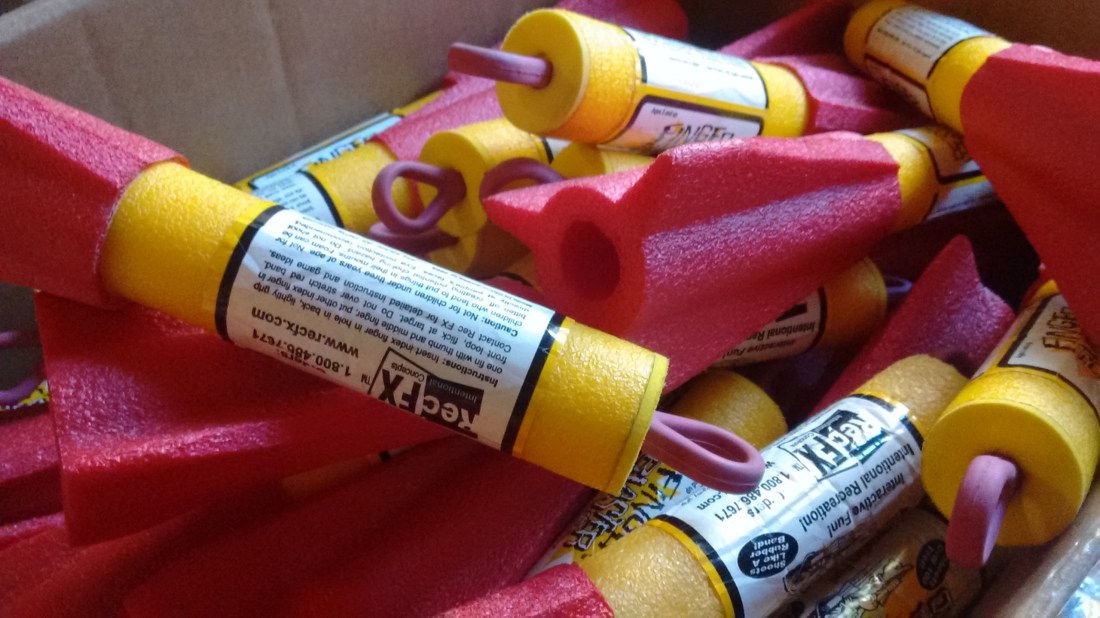
Long Live The Finger Rocket

We’re cleaning out the church resource room. Yesterday I arrived at my office to find a box of Finger Rockets on my desk, unearthed from beneath layers of curriculum and craft sediment.

IMG_20151119_113305600These things were all the rage at my youth group when I first arrived. Over time, too many were lost or broken to use them anymore. I went online to buy replacements and ended up with cheap ones that broke on the first use. I grew discouraged and Finger Rockets kind of went away as a thing our youth group played. There is no substitute for the yellow ones.

It makes me sad to know that there was a whole box of them right under my nose these past five years.

In honor of the Finger Rocket era of my tenure at Claremont, I’m posting here a poetic reflection offered by a former student, Jess Croughan, shared on Facebook upon seeing the above picture:

It was a cool June evening. There wasn’t much to be heard, save the wind through the trees and the scuff of shoes on linoleum. Suddenly from the north a snap of elastic! They came sailing from every direction; red and yellow agents of war sent with the one grim purpose of removing us all. I reached for my stash. There were screams, yells, and roars, the noise made one lose all sense of self. I was no longer just a PYG. I was a weapon, a juggernaut of destruction that couldn’t miss his mark. Victory came, but as always it was at a price. I don’t know how many we lost that night. In a way I was lost that night myself. But, we can’t dwell on the past, for there is the ever looming threat that always pushes us forward……the next round.

Long live the Ringer Rocket.

(note: always use with protective eyewear)

Sometimes It Works

Last month I wrote about how my church was fixing children’s time. We moved it into the Gathering movement of the liturgy, incorporated more movement, and started inviting congregants to join in the movement.

Today’s post is to share that it’s working.

Here’s how I know: my colleague does this great thing at session meetings where she invites elders to share where and how they have experienced The Spirit at work in our life together, and last night one of them said it was during the children’s times in worship.

I know, right?

The evidence that it’s working is that they’re making him feel more connected to the community of children in the church. That’s a work of The Spirit more than it is a work of organization or crowd control. It’s totally working.

Church leaders face many intractable problems that seem impervious to our most innovative efforts. Yet sometimes it works. The listening, talking, giving up, risking, experimenting–sometimes it all works.

Thanks be to God.

Brittle vs. Resilient Youth Ministry

Cribbing a Seth Godin post today.

Here’s the money quote:

Brittle organizations are focused on which end of the egg you open. Are you wearing the team jersey the right way, saying the incantations each time, saluting properly…

Resilient organizations are more focused on what you produce, and why.


Brittle youth ministries, then, focus on codes of expected behavior, be they abstinence from sex and alcohol, attendance at youth group, or writing a statement of faith that jives with the Apostles Creed.

Resilient youth ministries focus on the formation of people–human disciples of Jesus.

Are we producing teenagers who understand the narrative arc of scripture and who can see the conflicts of their own lives reflected in the Sarah, Mary, Jesus, and Paul?

Are we producing teenagers who want to invite their peers to church only because they love it and want to share their experience?

Are we producing teenagers who appreciate the distinctions between Christianity and other religions from a posture that combines both respect for non-Christian religions but also a full-throated appreciation of Christianity?

Finally, are we producing teenagers who are aware of the presence of God in their lives?

Of course, the teenagers we work with are equally “produced” by their school environments, families, peer groups, coaches, and cultural influences. Sometimes those other communities support what we’re aiming for; they mostly did in the golden era of establishment Protestantism. Sometimes they don’t.  A lot of evangelical para-church youth ministry was established on the premise that they almost always don’t, with the obvious exception of the family.

Given the time and influence we have with youth, the question I want to be asking is, “What kind of teenagers are we helping to produce.”